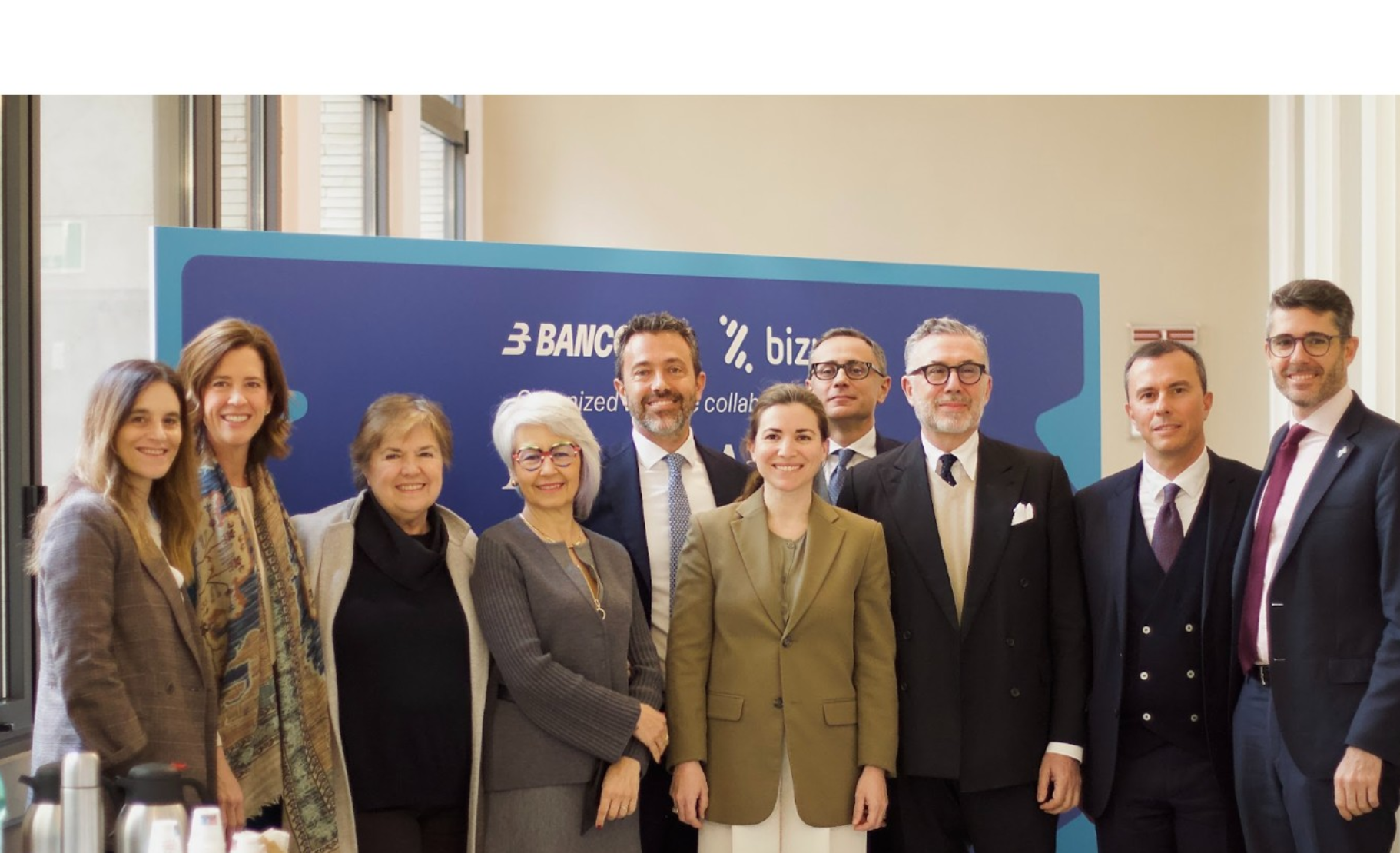
Bilateral meeting between Italy and Spain on the evolution of the European payments market
BANCOMAT, Bizum, ABI – Italian Banking Association and AEB – Asociación Española de Banca have agreed on the importance of accelerating the development of true European payments interoperability.
The central role of domestic schemes in the evolution of the payments market has been reaffirmed.
Rome, 26 March 2026 – National solutions today represent a strategic pillar to strengthen interoperability, security and autonomy within the European payments ecosystem. Furthermore, building strong European integration in the payments market is key to fully advancing the development of the European Single Market as a whole.
These are the key conclusions of the institutional and technical discussion titled “Interoperability and European Payments Sovereignty”, promoted today by Bancomat, the most widespread and recognized payment scheme in Italy, Bizum, ABI – Italian Banking Association and AEB – Asociación Española de Banca.
The meeting represents the first in a series of bilateral summits between Bancomat and its European partners.
The event was opened by Fabrizio Burlando, CEO of BANCOMAT, and Gianluca Tiani, Head of Strategy, Innovation & International Affairs Division at ABI, who highlighted how cooperation between domestic schemes is a key lever to support European development trajectories in retail payments, infrastructure resilience and digital innovation.
During the event, it clearly emerged that domestic models are already contributing concretely to building a more integrated and competitive payments market, fostering the development of common standards and interoperable solutions. In this context, collaboration among leading European players is intensifying to enable scalable platforms, strengthen security and fraud prevention mechanisms, and promote new use cases, including digital wallets and value-added services.
The subsequent roundtable featured Massimo Itta, Chief Commercial Officer of BANCOMAT; Fernando Rodríguez, Deputy Managing Director of Bizum; Rita Camporeale, Senior Advisor International Affairs & Payments at ABI; and Lorena Mullor Gómez, Digital Policy Advisor at AEB.
They explored the value of the Italy–Spain dialogue as an advanced laboratory for European integration.
The roundtable was moderated by María Abascal, Director General of AEB.
The discussion highlighted how established experiences in P2P payments and instant payments can converge towards shared models, enabling new forms of interoperability between domestic infrastructures. Italy and Spain, thanks to the maturity of their respective ecosystems, are contributing to defining innovative approaches that foster integration between national schemes, while preserving local specificities within a shared European vision.
Particular attention was given to the role of domestic infrastructures in ensuring operational resilience and service continuity—elements that are increasingly critical in a context of growing technological complexity and evolving cyber and fraud threats. In this scenario, strengthening technical cooperation among European operators represents a key enabler for the development of secure, reliable and sustainable solutions.
Participants also emphasized how dialogue among domestic schemes contributes to strengthening Europe’s competitiveness in the global payments landscape, while supporting strategic sovereignty objectives. The adoption of shared standards, infrastructure integration and the promotion of open ecosystems were identified as key elements to ensure autonomy, innovation and responsiveness to the needs of citizens and businesses.
The event was closed by Alejandra Kindelán, President of AEB – Asociación Española de Banca, who reiterated the importance of strengthening dialogue among European countries and continuing along the path of cooperation to build an increasingly integrated, resilient and competitive payments system.
The event confirmed that structured dialogue between national and international players is an essential step to support the evolution of the sector and to strengthen Europe’s role as a key player in digital payments innovation.
Share


Download
documents & support
Contact usPrivacy PolicyContest RulesEthics, Compliance and TransparencyTerms and conditionsStay tuned


BANCOMAT S.p.A.
Registered Office: Piazzale Luigi Sturzo 15, 00144, Roma
Offices in Milan: Piazza Vetra, 17, 20123, Milano
Tax code 04949971008 - Partita IVA 09591661005
Iscrizione al Registro delle imprese di Roma
REA n. 1210597
Share capital € 36.917.523,00 i.v.
The security of BANCOMAT Cards haas been tested by the Polytechnic University of Turin. Download technical report

Patent registered by BANCOMAT at national level
